Unraveling the Mystery of JWST's Little Red Dots: Could They Be 'Black Hole Stars'?
Recent observations from the James Webb Space Telescope (JWST) have revealed a population of puzzling objects known as 'little red dots' in the early universe. These faint, compact sources have left astronomers debating their true nature. Now, new X-ray data from one of these dots suggests a surprising possibility: they might be 'black hole stars'—hypothetical stellar giants powered by a central black hole instead of nuclear fusion. This Q&A explores the discovery, the evidence, and what it means for our understanding of cosmic evolution. Jump to specific questions: What are little red dots? | How do X-rays help? | What are black hole stars? | Why is X-ray detection significant? | Could they be early galaxies? | What future observations are needed?
What are the 'little red dots' discovered by the James Webb Space Telescope?
The James Webb Space Telescope, with its unprecedented infrared sensitivity, has spotted numerous small, reddish compact objects in images of the early universe, less than a billion years after the Big Bang. Dubbed 'little red dots', each appears as a tiny, intensely red source, often less than a few hundred light-years across—much smaller than typical galaxies at that epoch. Their color suggests they contain old stars or are heavily obscured by dust, but their exact composition and energy source remain mysterious. Early theories proposed they could be dense star clusters, active galactic nuclei (AGN), or even supermassive black holes in their infancy. However, the lack of clear X-ray or radio emission from most dots left astronomers puzzled. The new X-ray detection changes the game by offering a direct clue to the processes occurring within one of these enigmatic objects.
How do X-ray observations help identify these objects?
X-rays are a powerful tool for probing energetic phenomena in the cosmos. When matter falls into a black hole, it heats to millions of degrees, emitting copious X-rays. Similarly, processes like supernova remnants, neutron stars, or extremely hot gas can produce X-rays. By detecting X-rays from a little red dot, astronomers can look for signatures of an actively accreting black hole. In this case, the X-ray signal from one specific dot is weak but consistent with a black hole burning at a low rate. This rules out many non-black-hole explanations, such as pure starlight from compact galaxies, which would not produce such X-rays. Instead, the data points to a central engine—either a supermassive black hole in its early growth phase or the even more exotic 'black hole star' scenario. Without X-ray data, the dots remain ambiguous; with it, scientists can test models and narrow down the true identity.
What exactly are 'black hole stars'?
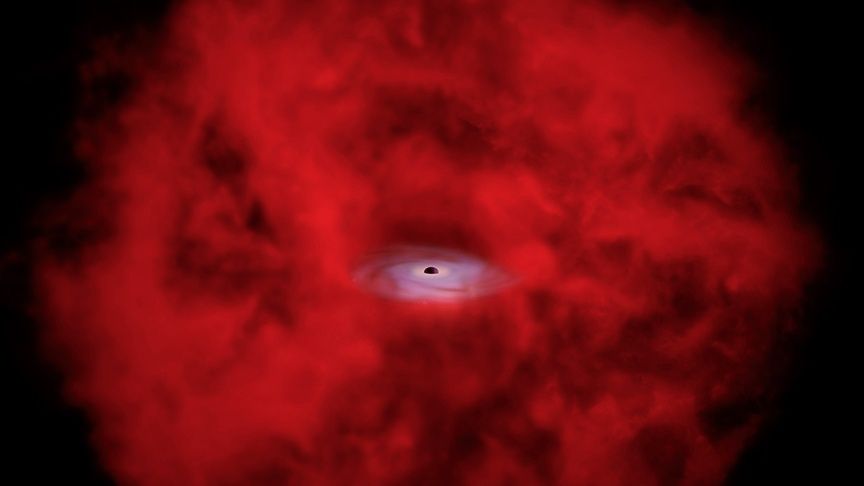
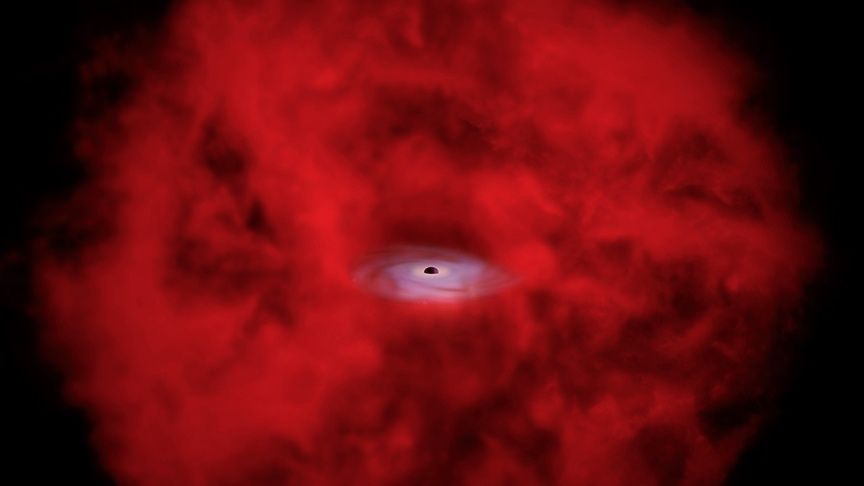
'Black hole stars' are a hypothetical class of stellar objects proposed by astrophysicists. Unlike ordinary stars, which sustain themselves through nuclear fusion in their cores, a black hole star would contain a small black hole at its center. This black hole would accrete surrounding gas and dust, releasing energy that prevents the star from collapsing under gravity—much like fusion does in a normal star. These exotic objects could reach masses thousands of times that of the Sun and shine brilliantly, but only for a relatively short time (tens of millions of years). They are thought to form in the early universe from dense gas clouds seeded with primordial black holes. If JWST's little red dots are black hole stars, they would represent a completely new stage in cosmic stellar evolution, bridging the gap between first stars and the supermassive black holes we see later. However, direct evidence remains elusive, making the X-ray detection a crucial piece of the puzzle.
Why is the detection of X-rays from a little red dot significant?
The detection of X-rays from one of the little red dots is a groundbreaking clue because it provides the first direct link between these faint, red objects and a high-energy process—likely a black hole. Previously, astronomers debated whether the dots were ultra-dense, dusty galaxies or early prototypes of quasars. The X-ray signature, although faint, is consistent with a black hole accreting gas at a low rate, matching the predictions for a black hole star better than for a typical AGN. If confirmed, it would mean that some of the first luminous objects in the universe were not ordinary stars or galaxies, but these unusual black-hole-powered stars. This could reshape our models of early structure formation and explain why JWST sees so many compact red sources that are too dim in other wavelengths. The X-ray data acts as a 'smoking gun', narrowing down the possibilities and encouraging further multi-wavelength follow-up to settle the mystery.
Could these little red dots be early galaxies instead of black hole stars?
Yes, the 'classic' interpretation for many little red dots is that they are compact galaxies in the early universe—perhaps extremely dense, massive galaxies with old stellar populations and heavy dust obscuration, which makes them appear red. In that case, their X-ray emission could come from X-ray binaries (neutron stars or black holes consuming companions) or hot interstellar gas, rather than a single central black hole. However, the observed X-ray properties of this particular dot seem distinct: the X-ray spectrum is hard, and the luminosity relative to the optical and infrared output is low, which better matches a moderately accreting black hole. Models of pure starlight plus normal X-ray sources cannot easily reproduce the exact ratios seen. While it's too early to rule out the galaxy hypothesis entirely, the black hole star idea offers a more elegant match, especially given the object's extreme redshift and compactness. Future observations with instruments like NASA's Chandra X-ray Observatory or the proposed AXIS mission will help distinguish between these scenarios by measuring variability and spectral features.
What future observations might confirm this theory?
To confirm whether these little red dots are truly black hole stars, astronomers need a multi-pronged approach. First, deeper X-ray observations from Chandra or future X-ray telescopes would look for variability—black hole accretion often flickers on short timescales (hours to days), which would be a telltale sign. Second, infrared spectroscopy with JWST itself could reveal emission lines (like those from ionized gas) that differ between a black hole star and a galaxy. Third, gravitational lensing might help resolve the tiny objects, showing whether they are point-like (like a star) or extended (like a galaxy). Fourth, radio observations with ALMA or the Square Kilometre Array could detect jets or outflows typical of accreting black holes. Finally, theoretical models must predict distinctive signatures—like a specific X-ray-to-optical ratio—that observers can test. The upcoming Athena X-ray observatory and the Nancy Grace Roman Space Telescope will also survey large areas, potentially finding more such dots. This convergence of data could soon transform the little red dots from a cosmic enigma into a new chapter in stellar and galactic evolution.