Ardent: On-Demand Postgres Sandboxes for AI-Powered Development Teams
Introduction
Modern AI coding agents are now capable of tackling complex engineering tasks that once required human oversight. But as these agents become more autonomous, a critical gap has emerged: they often lack access to realistic, production-like database environments for testing. Without such sandboxes, the code they generate can inadvertently corrupt production data or bring down entire systems. Enter Ardent (YC P26), a new tool from founders Vikram and Evan that delivers near-instant Postgres sandboxes designed specifically for both human developers and their AI counterparts.
The Challenge: Why Traditional Database Testing Fails for AI Agents
Vikram spent over a year building an AI Data Engineer that ultimately failed—precisely because the agent couldn't test its work against a realistic database layer. Evan, with 12 years of data engineering experience, encountered the same wall while building agents at his previous company. The core problem? Most AI agents ship code that works in theory but breaks in production, because they never had a safe, isolated playground that mirrored the real environment.
Standard development practices fall short: staging databases are often stale or incomplete, and creating full replicas of production databases is slow, expensive, and risky. Physical replication, the traditional method for creating copies, is unavailable on most hosted Postgres platforms. This leaves coding agents—and their human counterparts—with no good option for thorough testing.
How Ardent Solves the Sandbox Problem
Near-Instant Replication Without Migration
Ardent’s secret sauce is a replication stream that continuously pulls data from the target database, scaling via Kafka onto a read replica equipped with copy-on-write and autoscaling compute. The platform currently relies on Neon as its primary branching engine because of Neon’s superior implementation of these properties. This architecture allows Ardent to spin up production-like sandboxes in seconds—not hours.
Logical Replication and DDL Triggers for Any Hosted Postgres
To work with any hosted Postgres database, Ardent uses logical replication combined with DDL triggers. Since most cloud providers do not permit physical replication, logical replication provides a safe, non-disruptive way to mirror database state. The DDL triggers ensure that schema changes in production are automatically propagated to the sandbox environment, keeping it current without manual intervention.
Architecture: Kafka, Read Replica, Copy-on-Write, Autoscaling
Behind the scenes, Ardent writes the replication stream out of the target DB into Kafka, which handles high-throughput data movement. From there, data lands on a read replica with copy-on-write enabled—meaning each sandbox consumes minimal storage until it actually modifies data. Autoscaling compute ensures that sandboxes have enough horsepower for heavy testing but don't waste resources when idle. This combination delivers the dual benefit of speed and cost-efficiency.
Key Benefits of Ardent's Approach
- No platform migration required. Unlike solutions that force you to move your production database to a specific provider like Neon, Ardent works with any hosted Postgres database. This preserves your existing architecture while adding sandbox capabilities.
- Minimal impact on production. The use of logical replication and offloading to a read replica means that production performance is virtually untouched. Sandboxes can be created, used, and destroyed without heavy resource consumption.
- Rapid spin-up of clones. Because the replica is continuously updated and uses copy-on-write, new sandboxes are available in seconds. Developers and AI agents can iterate quickly without waiting for database refreshes.
- Strong separation of concerns. Production databases remain isolated from development and testing activities, reducing the risk of accidental data corruption or schema drift.
Founding Story: Lessons from Failure
The idea for Ardent was born out of direct, painful experience. Vikram’s AI Data Engineer project was a year-long effort that collapsed because the agent could not safely test its SQL against real data. Meanwhile, Evan spent over a decade in data engineering, watching teams struggle to provide safe testing environments for both human engineers and AI agents. They realized that the missing piece wasn’t better AI—it was better infrastructure for database testing. Ardent is that infrastructure, designed from the ground up to support the next generation of autonomous coding tools.
Getting Started with Ardent
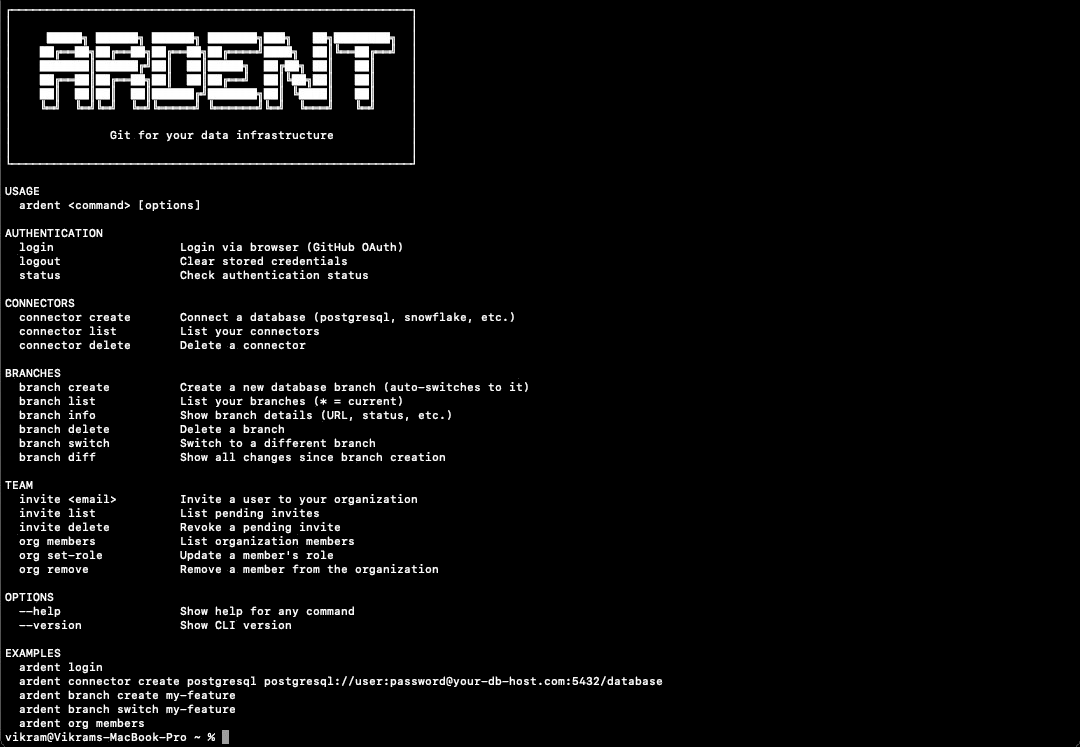
If your team is building with AI coding agents—or if you simply want to give your human developers instant, production-like Postgres sandboxes—Ardent offers a streamlined path. The tool integrates with your existing Postgres instance via lightweight connectors and provides a dashboard for managing sandbox lifecycles. For more details, visit tryardent.com.
This article was adapted from a Launch HN post by Vikram and Evan (YC P26).