Inside OpenAI's GPT-5.5 and Codex: A New Era of AI-Powered Productivity at NVIDIA
OpenAI's latest frontier model, GPT-5.5, now powers Codex, an agentic coding application that is transforming how developers and knowledge workers tackle complex tasks. Deployed on NVIDIA's cutting-edge GB200 NVL72 rack-scale systems, this combination is delivering unprecedented efficiency gains across the company. This Q&A dives into the technology, its internal adoption at NVIDIA, and the measurable impact on productivity and innovation.
What is Codex and how does GPT-5.5 enhance it?
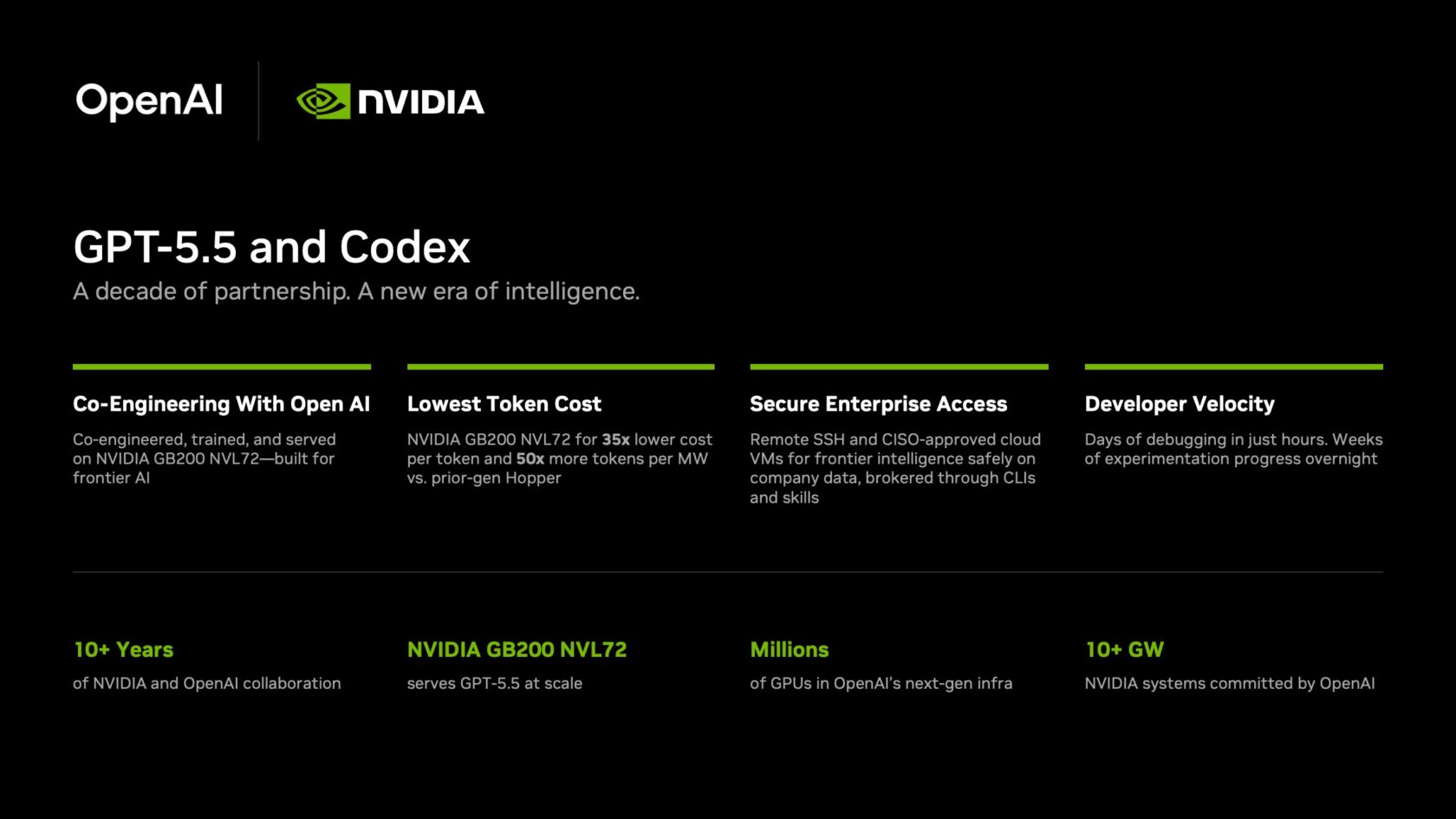
Codex is OpenAI's agentic coding app, now supercharged by GPT-5.5, the latest frontier model. It acts as an AI agent that can process information, solve complex problems, and generate code from natural-language prompts. With GPT-5.5 running on NVIDIA's GB200 NVL72 systems, Codex achieves remarkable efficiency: the new infrastructure delivers 35x lower cost per million tokens and 50x higher token output per second per megawatt compared to previous generations. This makes frontier-model inference viable at enterprise scale, allowing Codex to handle larger, more complex tasks without prohibitive costs or latency.
How is NVIDIA using Codex internally?
Over 10,000 NVIDIANs across engineering, product, legal, marketing, finance, sales, HR, operations, and developer programs are actively using Codex. They report 'mind-blowing' and 'life-changing' results. For example, debugging cycles that once took days are now completed in hours. Experimentation that required weeks can be done overnight, even in complex, multi-file codebases. Teams are shipping end-to-end features directly from natural-language prompts, with higher reliability and fewer wasted cycles than with earlier models. This broad adoption highlights Codex's versatility beyond just coding—it aids in any knowledge work requiring information processing and problem-solving.
What performance improvements does the GB200 NVL72 system offer?
The NVIDIA GB200 NVL72 is a rack-scale system optimized for AI workloads. When serving GPT-5.5, it provides 35x lower cost per million tokens and 50x higher token output per second per megawatt compared to prior-generation systems. These numbers translate into real-world speedups: tasks that were economically unfeasible or too slow become practical. For instance, the system can handle massive multi-file codebases with ease, enabling rapid iteration and experimentation. This efficiency is critical for enterprise-scale deployment, where both cost and power consumption matter.
How does Codex ensure enterprise-level security?
Security is paramount. Codex supports remote Secure Shell (SSH) connections to approved cloud virtual machines (VMs), allowing agents to access real company data without exposing it externally. NVIDIA IT has deployed dedicated cloud VMs for every employee, creating a secure sandbox for the agent to operate with full auditability. Users control the agent from a familiar interface. A zero-data retention policy governs the deployment, and agents access production systems with read-only permissions via command-line interfaces and Skills—the same agentic toolkit NVIDIA uses for internal automation workflows.
What is the history of collaboration between NVIDIA and OpenAI?
The partnership spans over a decade, starting in 2016 when NVIDIA founder and CEO Jensen Huang personally delivered one of the first DGX-1 systems to OpenAI. This full-stack collaboration has evolved through multiple generations of hardware and software. The GPT-5.5 launch and Codex rollout are the latest milestones, demonstrating a symbiotic relationship: NVIDIA provides optimized infrastructure, while OpenAI pushes the frontiers of AI model capabilities. This ongoing work helps both companies accelerate AI adoption and improve model efficiency for everyone.
What results have NVIDIA employees reported?
Employees across all departments—from engineering to HR—describe their experiences as 'mind-blowing' and 'life-changing.' Measurable gains include debugging cycles that formerly took days now closing in hours, and weeks-long experimentation turning into overnight progress. Teams can ship end-to-end features from natural-language prompts with stronger reliability. Jensen Huang himself urged employees via email: 'Let's jump to lightspeed. Welcome to the age of AI.' The combination of GPT-5.5's capability and the GB200 NVL72's efficiency has unlocked productivity leaps that were previously unimaginable at enterprise scale.
What does this mean for the future of AI agents and knowledge work?
Codex powered by GPT-5.5 on NVIDIA infrastructure marks a pivotal shift. AI agents are no longer limited to simple coding tasks—they now excel at knowledge work: processing information, solving complex problems, generating ideas, and driving innovation. The economic viability of frontier-model inference at scale allows companies to deploy agents across entire workforces. As NVIDIA and OpenAI continue their collaboration, we can expect even more efficient models and hardware, further accelerating the transition to an AI-augmented workplace where agents handle the heavy lifting of analysis and development.